

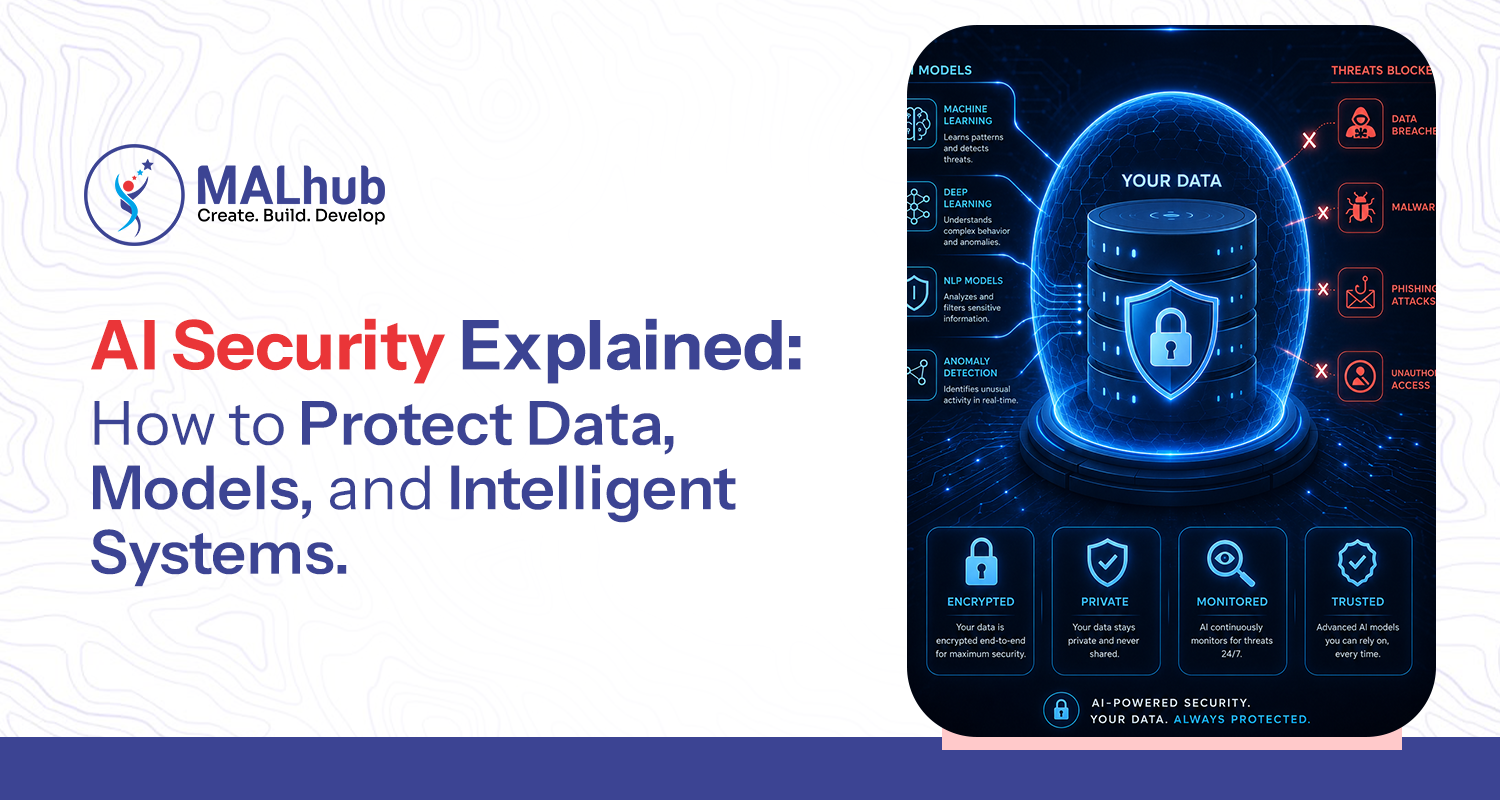
Artificial Intelligence is transforming industries at an unprecedented pace. From healthcare and finance to education and cybersecurity, AI systems are redefining how organizations make decisions, automate processes, and create value. However, as AI becomes more powerful, it also introduces a new generation of security risks that businesses and individuals cannot afford to ignore.
The same technology that enables innovation can also become a target for cybercriminals. Sensitive data can be stolen, machine-learning models can be manipulated, and intellectual property can be compromised. Consequently, AI security has evolved from a niche concern into a critical business priority.
Organizations worldwide are investing heavily in AI-powered solutions, yet many still underestimate the importance of securing the systems behind those innovations. In reality, AI security is not merely about protecting algorithms, it’s about safeguarding trust, privacy, and the future of digital transformation.
In this article, we’ll explore why AI security matters, the threats facing modern AI systems, and the strategies organizations can use to build secure and resilient intelligent systems.
Why AI Security Matters More Than Ever
Artificial Intelligence systems process enormous volumes of data. These datasets often contain sensitive customer information, financial records, medical histories, proprietary business insights, and confidential communications. Without proper security measures, these assets can quickly become targets for attackers.
Furthermore, AI systems increasingly make decisions that affect millions of people. Recommendation engines influence consumer behavior, fraud-detection models protect financial institutions, and autonomous systems control critical infrastructure. Therefore, any compromise of these systems could have far-reaching consequences.
As organizations continue to integrate AI into their operations, ensuring the security of these technologies becomes essential for maintaining public trust and operational stability.
Understanding the Growing Threat Landscape
Traditional cybersecurity threats have evolved alongside Artificial Intelligence. Attackers are no longer limited to stealing passwords or deploying malware. Instead, they are targeting the very foundation of AI systems.
Modern threats against AI include:
- Data poisoning attacks
- Prompt injection attacks
- Intellectual property theft
- Model inversion attacks
- Adversarial machine learning
- Unauthorized model access
- Training data manipulation
- AI-generated misinformation
Because AI systems rely heavily on data and automation, even a small vulnerability can produce significant consequences across an organization.
As a result, businesses must adopt proactive security strategies that address the unique risks associated with AI technologies.
Data Poisoning: Corrupting AI From the Inside
Data is the fuel that powers Artificial Intelligence. Unfortunately, it is also one of the most vulnerable components of any AI system.
Data poisoning occurs when attackers deliberately inject malicious or misleading information into training datasets. Once the model learns from corrupted data, its predictions and decisions become unreliable.
For example, an attacker could manipulate a fraud-detection system by introducing false transaction patterns into the training data. Similarly, compromised healthcare datasets could lead to inaccurate diagnoses or treatment recommendations.
Because machine-learning models depend on high-quality data, organizations must implement strict data validation, access controls, and monitoring systems to detect suspicious changes before they impact performance.
Prompt Injection: Exploiting the Language of AI
Large language models and conversational AI systems rely on prompts to generate responses. However, attackers can exploit this dependency through prompt injection attacks.
Prompt injection occurs when malicious instructions are embedded into user inputs or external data sources, causing the AI system to ignore its intended behavior.
For example, an attacker might trick an AI assistant into revealing confidential information, bypassing safety controls, or generating harmful outputs.
As AI-powered applications become more common in customer support, content generation, and enterprise workflows, organizations must develop robust safeguards against prompt manipulation.
This includes input filtering, output validation, contextual restrictions, and continuous monitoring.
Protecting Intellectual Property in the Age of AI
Artificial Intelligence models represent significant investments in research, data collection, engineering, and innovation. Consequently, intellectual property theft has emerged as a major concern.
Cybercriminals and competitors may attempt to steal proprietary algorithms, replicate models, or extract sensitive information embedded within AI systems.
Model theft not only creates financial losses but also undermines an organization’s competitive advantage.
To protect intellectual property, companies should implement encryption, access management, watermarking techniques, and strict authorization policies.
Protecting AI models is not simply about securing code—it’s about preserving years of innovation and expertise.
Adversarial Attacks and Model Manipulation
AI systems can be manipulated in subtle ways that humans may not immediately recognize.
Adversarial attacks involve deliberately modifying input data to deceive machine-learning models. For instance, tiny changes to an image may cause an AI-powered security system to misidentify an object entirely.
Similarly, attackers can manipulate recommendation systems, autonomous vehicles, facial recognition software, and fraud-detection systems by exploiting weaknesses in model architecture.
Because of these risks, organizations must continuously test AI systems against adversarial scenarios and strengthen their resilience through robust model evaluation.
Security testing should become a standard part of the AI development lifecycle.
Building Secure AI Systems: Best Practices for Organizations
Protecting AI systems requires more than installing traditional cybersecurity tools. Organizations need comprehensive strategies designed specifically for intelligent technologies.
Several best practices can significantly improve AI security:
- Encrypt sensitive data at rest and in transit.
- Restrict access to training datasets and AI models.
- Implement multi-factor authentication.
- Continuously monitor model behavior.
- Validate and sanitize user inputs.
- Conduct regular security audits.
- Test systems against adversarial attacks.
- Maintain secure cloud infrastructure.
- Establish incident-response plans.
By combining these practices, organizations can reduce risk while maintaining the benefits of AI innovation.
The Human Element in AI Security
Technology alone cannot solve every security challenge. Human awareness remains one of the most important defenses against cyber threats.
Employees, developers, and decision-makers must understand the risks associated with Artificial Intelligence and follow security best practices.
Organizations should invest in cybersecurity awareness programs that teach teams how to identify phishing attacks, protect sensitive information, recognize social-engineering tactics, and secure AI systems.
Additionally, security teams and AI engineers must collaborate closely to ensure that innovation and protection evolve together.
The future of AI security depends as much on people as it does on technology.
AI Security and the Future of Cybersecurity
Artificial Intelligence is reshaping cybersecurity itself. Security professionals now use AI to detect threats, analyze network behavior, automate incident response, and identify vulnerabilities faster than ever before.
However, cybercriminals are also leveraging AI to launch more sophisticated attacks.
This creates an ongoing race between defenders and attackers, making cybersecurity expertise increasingly valuable in the modern workforce.
As AI adoption accelerates, professionals with skills in cybersecurity, machine learning, cloud computing, and data protection will play a critical role in securing the digital future.
Understanding AI security today means preparing for the challenges of tomorrow.
Build Future-Ready Cybersecurity Skills with MALhub
If you want to develop practical cybersecurity skills for the modern AI-driven world, MALhub’s Cybersecurity Virtual Program offers hands-on training designed for today’s evolving threat landscape.
Our program equips learners with practical knowledge in:
- Network Security
- Information Security
- Threat Detection
- Vulnerability Assessment
- Incident Response
- Cloud Security
- Modern Cybersecurity Practices
Whether you’re a student, graduate, entrepreneur, or working professional, cybersecurity skills can help you protect digital systems while unlocking exciting career opportunities.
Invest in Your Future Today
📧 Email: [email protected]
📞 Call: +234 816 895 3635
👉 Enroll in MALhub’s Cybersecurity Course: https://malhub.org/cybersecurity-virtual/







2 Responses
How can businesses integrate AI security into their cybersecurity strategies to detect emerging threats, reduce human error, and protect sensitive data without creating new risks from AI itself?
Great question! The key is using AI for real-time threat detection while keeping humans in the loop for critical actions—plus wrapping your AI tools in strong guardrails like DLP and prompt sanitization so the tech doesn’t become the risk.