
Technology is changing the way children learn, communicate, create, and eventually work.
For many Nigerian parents, this raises an important question: Should my child be learning how to code?
The answer is increasingly worth considering.
Coding is no longer a skill reserved for university students, professional software developers, or children who already know that they want careers in technology. With the right approach, children can begin learning computational thinking, problem-solving, creativity, and basic programming concepts at an early age.
As Nigeria continues to expand its digital-learning ecosystem, parents have an opportunity to introduce children to technology in a way that goes beyond entertainment and passive screen time. Nigeria’s National EdTech Strategy 2025–2030 specifically recognizes digital transformation, teacher capacity, infrastructure, content innovation, and responsible AI use as important parts of the country’s education ecosystem.
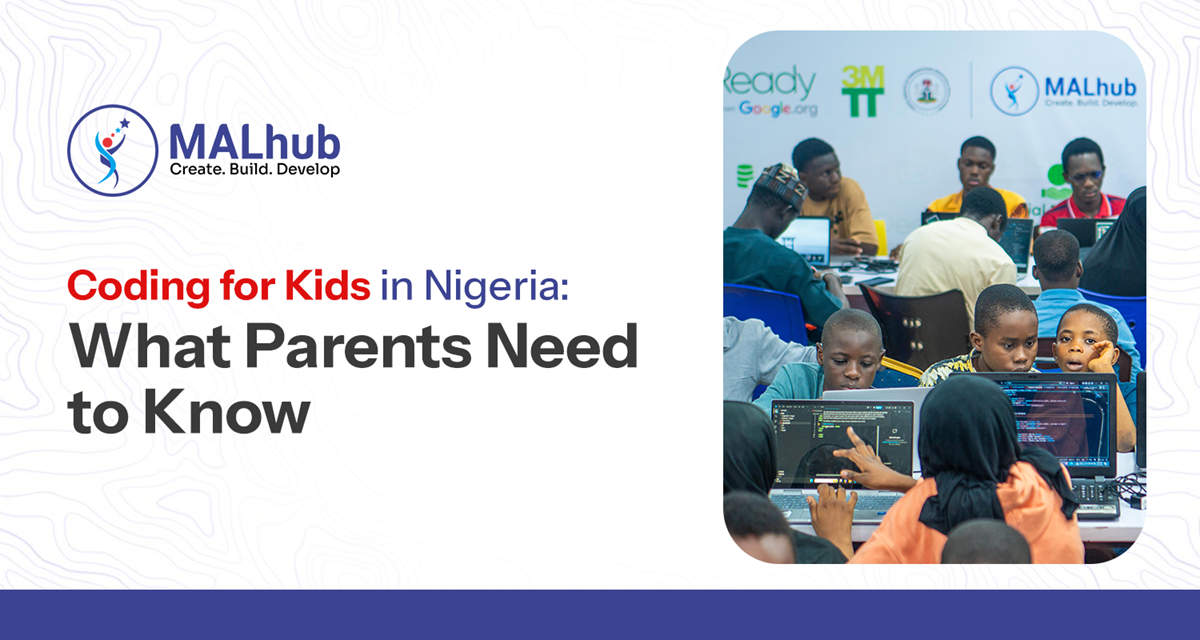
After recently completing another Summer Kids Coding programme at MALhub, these questions become even more relevant:
What should parents really know before enrolling their children in a coding programme?
1. Coding Is More Than Learning a Programming Language
When parents hear the word “coding,” they often imagine complicated programming languages, difficult syntax, and professional software development.
For children, however, coding can begin much more simply.
A child can start by learning how instructions work, how to break a problem into smaller steps, how events trigger actions, and how one decision can produce different results.
This is why visual programming environments such as Scratch can be particularly useful for beginners. Instead of immediately worrying about complicated syntax, children can focus on logic and creativity by connecting programming blocks to create stories, animations, games, and interactive projects.
The real educational value is not simply that a child can make a game.
It is that the child begins to understand how things work.
Instead of only consuming technology, the child starts asking:
“How can I build something with this?”
That change in mindset is one of the most valuable outcomes of early coding education.
2. Why Coding Makes Sense for Nigerian Children
Nigeria has a young population and a rapidly changing digital economy. At the same time, access to quality digital education remains uneven.
UNICEF has reported significant challenges around digital access and digital literacy in Nigeria, including limited infrastructure and gaps in digital skills. Its Nigeria Learning Passport initiative has expanded access to digital learning resources for millions of children and young people.
This context makes digital skills increasingly important.
Children growing up today will enter a world where technology will influence almost every profession. A child may eventually become a doctor, architect, entrepreneur, teacher, engineer, designer, accountant, scientist, marketer, or software developer.
They will still interact with technology.
Therefore, the objective of coding education should not be to turn every child into a professional programmer.
The objective should be to help children become confident creators and problem-solvers in a digital world.
3. Your Child Does Not Have to Be “Good at Mathematics” to Learn Coding
One common concern among parents is whether their child is strong enough academically to learn programming.
Coding does involve logical thinking, but a child does not need to be a mathematics genius before starting.
In beginner-friendly coding programmes, children gradually learn concepts such as sequences, conditions, repetition, variables, events, and problem-solving.
These concepts can be introduced through practical activities rather than abstract theory.
For example, a child creating a simple game might need to decide:
“What should happen when the player presses this button?”
That question introduces logic.
Another child might ask:
“How can I make this character repeat the same movement?”
That introduces repetition and automation.
A child might then discover that the game behaves incorrectly and begin testing different solutions.
That introduces debugging.
In this way, children learn computational thinking through experimentation.
The objective is not to make the child memorize programming terminology.
The objective is to teach the child how to think.
4. Good Kids Coding Programmes Should Be Project-Based
Children learn differently from adults.
A two-hour lecture about programming concepts may not keep a young learner engaged for long.
Children need opportunities to experiment, create, make mistakes, try again, and see the results of their decisions.
This is why project-based learning is particularly important in children’s coding education.
Instead of spending an entire programme learning definitions, children can work toward projects.
They might create:
- A simple game
- An interactive story
- An animation
- A basic website
- A quiz
- A digital presentation
- A small programming project
- A creative technology challenge
Projects give children something tangible to work toward.
More importantly, projects create a sense of ownership.
There is a significant difference between saying:
“I attended a coding class.”
and saying:
“I built this.”
That second statement can create confidence.
It can also encourage children to continue learning beyond the classroom.
5. Coding Should Develop Creativity, Not Kill It
Technology education should not become another rigid academic subject where children simply memorize information.
The strongest children’s coding programmes create room for imagination.
Give two children the same coding challenge and they may produce completely different results.
One child might create a racing game.
Another might create an educational quiz.
Another might create an animated story.
Another might design something completely unexpected.
That freedom matters.
Coding gives children a structured environment where creativity has rules but still has room to grow.
They learn that there can be multiple solutions to a problem.
They learn that failure does not necessarily mean they are wrong.
Sometimes, failure simply means they need to test another approach.
This is an important mindset beyond technology.
6. Parents Should Look Beyond Certificates
A certificate can be useful.
But parents should be careful about making certificates the primary measure of success.
When evaluating a children’s coding programme, ask deeper questions.
What did my child actually build?
What did my child learn?
Can my child explain what they created?
Did my child enjoy the experience?
Did the programme encourage problem-solving?
Was my child given opportunities to experiment?
Did the instructors understand how to teach children?
A certificate tells you that a child participated in a programme.
A completed project can show you what the child actually experienced.
This is why parents should pay attention to practical outcomes, not only certificates.
The long-term objective should be to develop skills, confidence, curiosity, and a desire to keep learning.
7. Coding Education Should Be Age-Appropriate
Not every child should learn programming in the same way.
A five-year-old and a thirteen-year-old may both be interested in technology, but their learning experiences should be different.
Younger children may benefit from visual programming, games, storytelling, simple challenges, and highly interactive activities.
Older children may be ready for more structured programming concepts, web development, Python, app development, or other technical pathways.
This is why parents should ask about the curriculum before registering their children.
A good programme should consider:
- The child’s age
- Previous experience
- Attention span
- Learning pace
- Technical ability
- Interests
- Project complexity
The goal is not to make learning unnecessarily difficult.
The goal is to make it challenging enough to encourage growth without becoming discouraging.
8. Screen Time and Learning Time Are Not the Same Thing
Many parents are understandably concerned about the amount of time their children spend in front of screens.
That concern is valid.
However, not all screen time has the same purpose.
There is a difference between spending hours passively scrolling through social media or watching random videos and spending structured time designing a game, creating a website, solving a programming challenge, or learning how technology works.
The conversation should therefore move from simply asking:
“How much screen time does my child have?”
to asking:
“What is my child doing with that screen time?”
Technology can be used for entertainment, but it can also become a tool for education, creativity, communication, research, and creation.
Parents should encourage balance while helping children understand that devices are not only entertainment machines.
They are also tools for building.
9. Parents Still Have an Important Role After the Class
A coding programme cannot do everything by itself.
Parents play an important role in helping children maintain their interest after the programme ends.
Ask your child what they learned.
Ask them to demonstrate a project.
Let them explain how something works.
Celebrate their attempts, not just perfect results.
If they encounter an error, avoid immediately fixing everything for them.
Instead, ask:
“What do you think went wrong?”
“What have you tried already?”
“What could we test next?”
These questions encourage independent thinking.
Parents can also provide opportunities for children to practise at home. A child who spends several weeks learning coding but never touches technology again may quickly lose confidence.
The goal should be to turn coding from a holiday activity into an ongoing learning journey.
10. AI Is Changing Coding Education Too
There is another reason parents should think differently about coding education today: artificial intelligence.
Children are growing up in a world where AI can generate code, explain programming concepts, create images, answer questions, and assist with projects.
This does not make coding education unnecessary.
In many ways, it makes foundational understanding more important.
If a child uses AI to generate code, they should eventually understand what that code does.
They should be able to ask questions.
They should be able to identify errors.
They should understand that AI can make mistakes.
They should learn responsible and safe technology use.
Most importantly, children should learn that AI is a tool—not a replacement for thinking.
A child who understands programming concepts can use AI more intelligently than a child who simply copies whatever an AI tool produces.
This is why modern coding education should increasingly combine coding, creativity, digital literacy, AI awareness, and critical thinking.
Conclusion: Start With Curiosity, Not Pressure
Parents do not need to pressure children into choosing technology careers.
They simply need to give them opportunities to explore.
A child who learns to code today may not become a professional developer tomorrow. But they may become more comfortable with technology, more confident when solving problems, more willing to experiment, and more curious about how the digital world works.
And sometimes, that curiosity is where the journey begins.
Our recent Summer Kids Coding programme at MALhub reminded us of something simple but powerful:
Children learn best when they are given the opportunity to create.
So, if your child is curious about games, websites, apps, computers, artificial intelligence, or technology, don’t dismiss that curiosity.
Give them a safe place to explore it.
Because the future will not only need children who know how to use technology.
It will need children who understand it, question it, create with it, and use it to solve problems.