
Artificial intelligence is transforming the digital world at an unexpected pace. From automating workflows to improving healthcare, finance, education, and communication, AI has become deeply integrated into modern society. However, while AI creates opportunities for innovation and growth, it also introduces a new generation of cybersecurity threats that are faster, smarter, and more difficult to detect.
Cybersecurity in the AI era is no longer a simple battle between hackers and firewalls. It has evolved into a continuous, machine-speed arms race where both attackers and defenders use artificial intelligence to outmaneuver each other. Cybercriminals now leverage AI to automate phishing attacks, generate deepfakes, and discover vulnerabilities before organizations can respond. At the same time, businesses rely on AI-powered cybersecurity tools to detect anomalies, automate incident response, and strengthen digital defenses.
As organizations continue to adopt AI technologies, understanding the future of cybersecurity has become essential. Companies that fail to adapt risk exposing their systems, data, and customers to increasingly sophisticated cyber threats.
The Rise of AI-Powered Cyber Threats
The cybersecurity landscape has changed dramatically over the last few years. Traditional attacks that once required significant manual effort can now be executed at scale through AI automation. This shift has made cybercrime more efficient, more targeted, and far more dangerous.
Attackers no longer rely solely on basic malware or generic phishing emails. Instead, they use AI-driven tools capable of analyzing human behavior, generating convincing content, and identifying weaknesses in digital systems faster than ever before.
This transformation means organizations must rethink how they approach digital security in an AI-driven world.
AI-Augmented Phishing and Social Engineering Attacks
Phishing remains one of the most common cyber threats globally, but artificial intelligence has elevated it to a new level. Generative AI tools now allow attackers to create highly personalized emails, messages, and scripts that appear authentic and trustworthy.
Unlike traditional phishing attempts filled with spelling errors and suspicious formatting, AI-generated phishing messages are grammatically accurate, context-aware, and emotionally persuasive. These attacks can mimic executives, colleagues, or trusted brands with alarming precision.
As a result, traditional spam filters struggle to identify these threats effectively. Employees and individuals are increasingly vulnerable because AI-powered phishing attacks exploit trust and human psychology more efficiently than ever before.
Organizations must now combine cybersecurity awareness training with AI-driven detection systems to reduce the risk of social engineering attacks.
The Growing Threat of Deepfakes and Synthetic Identity Fraud
One of the most alarming developments in the AI era is the rise of deepfake technology. Attackers can now use AI to replicate voices, faces, and even mannerisms convincingly enough to deceive employees, customers, and executives.
Deepfake scams have already been used to authorize fraudulent financial transactions, manipulate business decisions, and impersonate senior executives during virtual meetings. As AI models improve, distinguishing between real and synthetic content becomes increasingly difficult.
Beyond financial fraud, synthetic identity attacks also threaten digital trust itself. Cybercriminals can generate fake identities supported by AI-generated documents, photos, and communication patterns. This creates significant challenges for identity verification systems across banking, e-commerce, and corporate environments.
To combat this growing threat, organizations must adopt advanced verification methods and strengthen identity authentication systems.
Enroll in MALhub’s Cybersecurity Course
Automated Vulnerability Discovery and Zero-Day Exploits
AI has also changed how cybercriminals discover and exploit vulnerabilities. Traditionally, identifying software flaws required time, technical expertise, and manual analysis. Today, AI models can scan large codebases, identify weaknesses, and even generate exploit strategies automatically.
This creates a dangerous situation where attackers can deploy zero-day exploits before developers have time to release security patches. AI-driven vulnerability discovery dramatically reduces the window between identifying a weakness and exploiting it.
Furthermore, attackers can automate these processes across multiple systems simultaneously, increasing the scale and speed of cyberattacks.
As software ecosystems grow more complex, organizations must adopt proactive cybersecurity measures capable of identifying vulnerabilities before attackers do.
Adversarial AI and Attacks on AI Systems
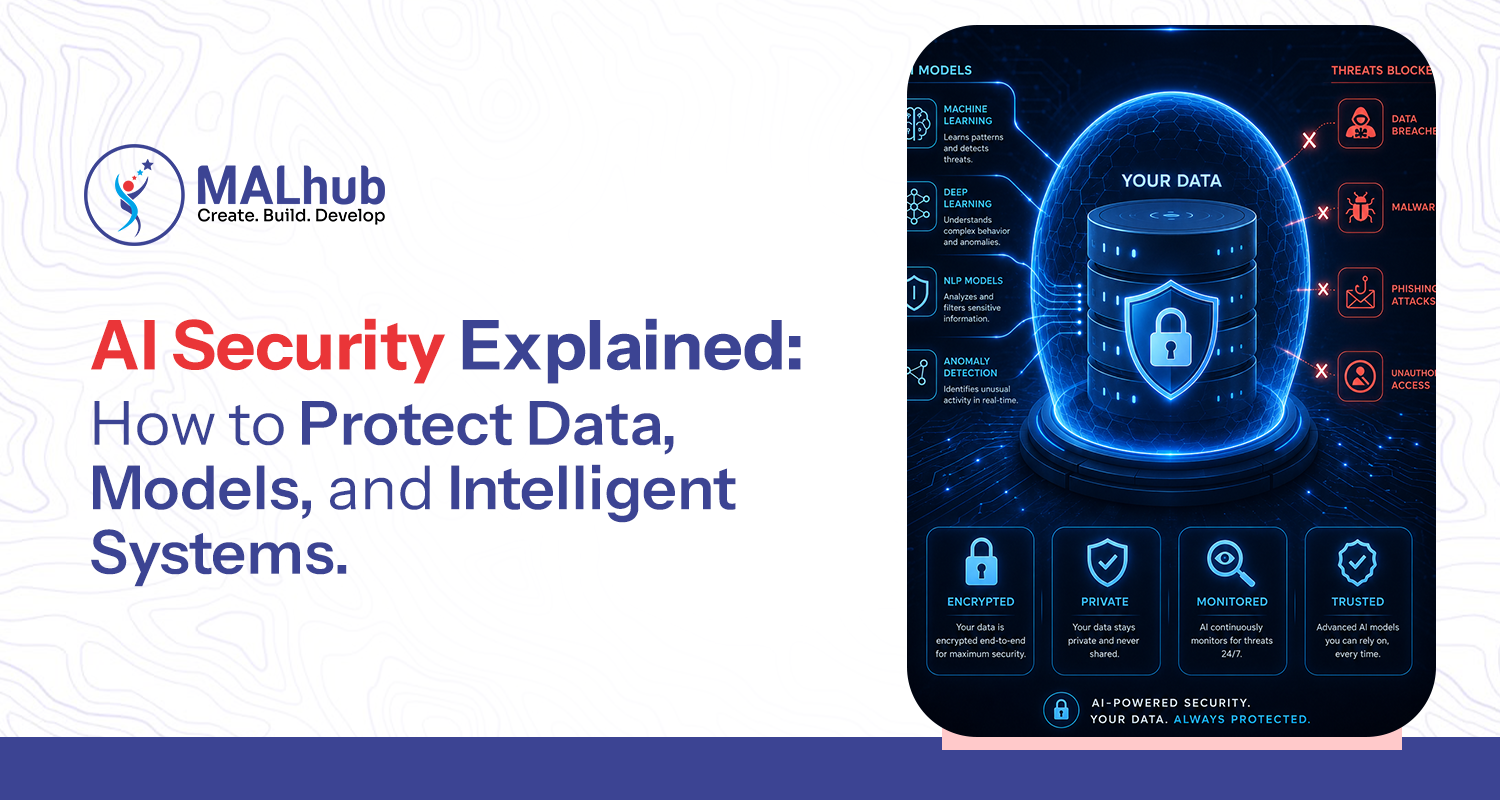
While AI strengthens cybersecurity defenses, it also introduces a new attack surface. Threat actors increasingly target the AI systems themselves through adversarial attacks.
One common technique involves poisoning training data. Attackers manipulate the information used to train AI models, causing the systems to make inaccurate or harmful decisions. In cybersecurity environments, this could lead to threat detection failures or incorrect automated responses.
Another method involves manipulating AI inputs to bypass security controls. By subtly altering data, attackers can trick AI systems into misclassifying malicious activity as harmless behavior.
These risks highlight an important reality: organizations must secure not only their networks and applications but also the AI models powering their operations.
How AI is Strengthening Cybersecurity Defenses
Despite these growing threats, artificial intelligence also represents one of the most powerful defensive tools available to cybersecurity professionals.
Modern Security Operations Centers (SOCs) rely heavily on AI-driven analytics to process massive amounts of network data in real time. AI systems can identify unusual behavior patterns, detect malware variants, and flag suspicious activity far faster than human analysts alone.
This capability is especially important as organizations face increasingly complex cyber threats across cloud environments, remote work systems, and connected devices.
AI-powered cybersecurity tools help businesses improve visibility, reduce response times, and minimize human error in security operations.
Agentic AI and Automated Incident Response
One of the most transformative developments in cybersecurity is the rise of agentic AI systems. These intelligent AI agents can investigate alerts, isolate compromised systems, and initiate remediation processes automatically.
Instead of waiting for human intervention, AI-driven security systems can respond instantly to active threats. For example, if suspicious activity is detected on a company network, an AI agent may automatically disconnect the affected device, block malicious traffic, and launch an investigation.
This level of automation significantly reduces the impact of cyberattacks while allowing security teams to focus on more strategic tasks.
As cyber threats continue to evolve at machine speed, automated incident response will become a critical component of modern cybersecurity strategies.
AI-Powered Red Teaming and Security Testing
Organizations are also using defensive AI to simulate cyberattacks against their own systems. This practice, commonly known as AI-powered red teaming, helps identify vulnerabilities before real attackers can exploit them.
AI-driven simulations can test security controls, evaluate employee responses, and uncover hidden weaknesses across networks and applications. Unlike traditional penetration testing, AI-powered testing can run continuously and adapt dynamically to changing environments.
This proactive approach enables organizations to strengthen their cybersecurity posture before threats emerge.
Why Zero Trust Security Matters More Than Ever
The AI era has exposed the limitations of traditional perimeter-based security models. Cybercriminals increasingly bypass firewalls by targeting trusted users, devices, and internal systems.
As a result, organizations are shifting toward Zero Trust Security frameworks. Zero Trust operates on a simple principle: never trust, always verify.
Under this model, every user, device, and system interaction requires continuous authentication and validation. This approach helps reduce insider threats, credential abuse, and unauthorized access.
The Importance of Workforce Upskilling in Cybersecurity
Technology alone cannot solve cybersecurity challenges. Organizations also need skilled professionals capable of understanding and managing AI-driven security systems.
Unfortunately, the global cybersecurity skills shortage continues to grow. Many companies struggle to find professionals with expertise in:
- Ethical hacking
- Threat analysis
- Cloud security
- AI-powered cybersecurity tools
- Incident response
As cyber threats become more sophisticated, continuous learning and workforce upskilling are critical for both individuals and organizations.
Professionals who understand cybersecurity in the AI era will be better positioned for career growth and leadership opportunities in the tech industry.
Build Future-Ready Cybersecurity Skills with MALhub
If you want to develop practical cybersecurity skills for the modern AI-driven world, MALhub’s Cybersecurity Virtual Program offers hands-on training designed for today’s evolving threat landscape.
The program helps learners build expertise in:
- Network security
- Ethical hacking
- Threat detection and analysis
- Security operations
- Real-world cybersecurity workflows
Whether you are starting your cybersecurity journey or upgrading your existing skills, the program provides the practical experience needed to thrive in the AI era.
Invest in your future today
Enroll in MALhub’s Cybersecurity Course
Email: [email protected]
Call: +234 816 895 3635